My family recently tried ancestry.com and we found out we are mostly Scandinavian so I thought I would try to tie this music post into that somehow. Scandinavia encompasses Denmark, Sweden, and Norway. I’m deciding to focus on a type of Swedish Folk Music because there is some pretty good information on it.
History:
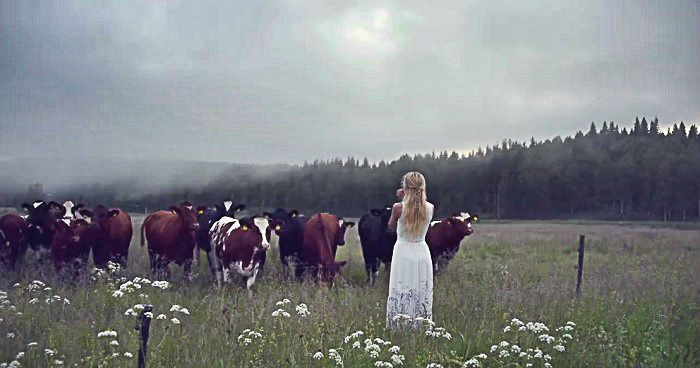
Swedish folk music is typically characterized by its “blue tones”, which are quarter and half tones. Which give Swedish folk song a sort of eerily sung story telling sound. These tones originated from Kulning otherwise known as herding calls that were sung by women to call in some form of cattle from sheep to cows.
This is an example of how a kulning would be sung to draw in a herd. Also don’t mind the part at the end.
Around 1350 the Nyckelharpa was invented. This instrument also known as the “key fiddle” became popular and was integrated into Swedish folk music throughout the 15th and 16th century. However the fiddle entered the seen in the 17th century and quickly became the instrument of choice. Stringed instruments then became an essential part to this genre.
This next video is a great example because it is pretty much an evolved kulning and it is sung accompanied by a nyckelharpa. The kulning has been made more song like and has been transformed with the addition of the instruments melodies. I think it is really pretty however the music video gives it a sort of creepy feel to it.
Form:
This type of music is very distinctive because of its contrast of long and drawn out notes followed by short and louder bursts in pitch. In the first video where the singer is actually singing a traditional kulning it is very clear. It makes sense that the pitch is high because the call would need to travel very far in order to get the attention of all of the livestock.
Beat:
In terms of beat in the traditional video it seems really inconsistent mostly because it isn’t necessarily a “song”. But in the more modern version it is along the same lines in terms of being fairly slow paced. I could’t find anywhere online that had the beat of this song so I took out a metronome and found it was around 48 bpm.
Not all too important but I thought it was cool to know that kulning was used in the soundtrack in the movie Frozen.
Work Cited:
Vartan, Starre. “Kulning: The Haunting, Beautiful Swedish Herding Call That’s Also a Song.” MNN, Mother Nature Network, 5 June 2017, http://www.mnn.com/lifestyle/arts-culture/blogs/kulning-haunting-beautiful-swedish-herding-call-thats-also-song.
“The Evolution of Swedish Folk Music.” The Evolution of Swedish Folk Music | Swedish Press, http://www.swedishpress.com/article/evolution-swedish-folk-music.
 Onyx Odyssey
I really enjoyed your blog. The kulning reminded me a lot of my grandma. She raised my sister and I on a farm and would always call our cows, goats, horses and donkeys like that. I thought maybe she was just being weird because I’d never heard anyone else do that.
The music itself reminded me of the movie “The Secret of Roan Inish.” It has very similar sounding music and eeriness to it, but it is Irish. I know that those places aren’t too far apart and maybe they influenced each other?
LikeLiked by 1 person
The second video you shared is beautiful! I love the sounds of the kulning, and the nyckelharpa is such a unique instrument. The second video does have sort of a haunting feel to it, but it might be due to the setting, but it sounds so good! Myrkur sounds a lot like some other folk metal/experimental folk music made by some other artists I’ve heard – similar, but they’re definitely different. I’m definitely going to have to dive deeper into this genre though, it’s so interesting!
LikeLiked by 1 person
How beautiful! I had seen the first video before so I had an idea of what the sound would be. But the information about the string instruments role in the history of the music was great information. That instrument from the second video, the nyckelharpa, I’ve never seen anything like it! Fantastic post, good job!
LikeLike